
Deep Healing Takes Time
Thanks for all you are doing to advance integrative veterinary medicine! I wanted to give you a detailed account of my time with my dog Fender and canine distemper virus.
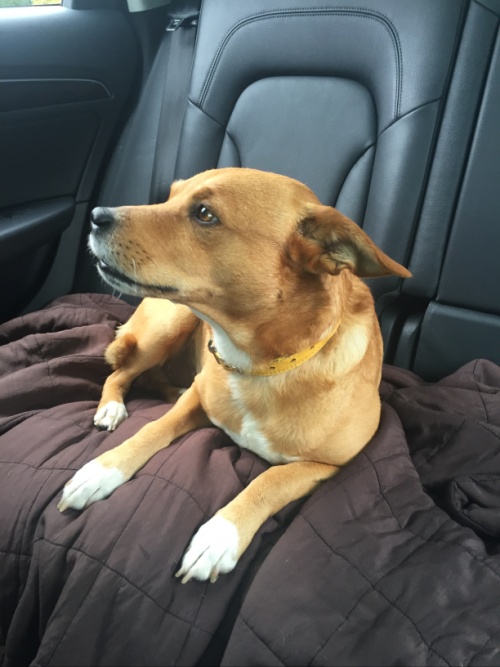
Fender contracted distemper just before he turned 5.
He almost never had health problems before that, so when he began vomiting and having diarrhea for a few days in a row I knew something was really off. I took him to the veterinarian I went to at the time, they ran some tests, and told me he must have ate something funny off the street. I explained he doesn’t ever do that, and they sort of rolled their eyes. A few days later the diarrhea and vomiting stopped, but he didn’t seem to have much of an appetite. I figured it was just him getting over whatever he had.
Then a week or so later, the wheezing came. But, it was spring and my friends all had allergies, and everyone convinced me dogs get allergies too. So I ignored it. He still didn’t want to eat very much and seemed a bit depressed or bored. He’s normally the happiest dog I know, so all of this seemed odd but not alarming.
Then a week or so after that stopped, one day he was laying on the floor next to my desk, and his right front paw started to twitch on the floor. Tic, tic, tic. It wouldn’t stop. That’s when my neighbor told me his distemper puppy ‘may have’ still been contagious when he and Fender met. I took him back to the vet who did more blood work, and they advised I admit him to a hospital immediately. I took him to a large referral, critical care and multispecialty referral clinic and they told me he had a white blood cell count of 250. They put him on an IV drip, ran an EKG, and put him in quarantined ICU overnight.
From there, everything with Fender went sideways.
The tic in his right front paw became a tic in his right front leg. Then the left one. Then the back legs. And the tic was so extreme that he couldn’t walk without falling down. He smacked his face on the ground about 30 times a day, during the few minutes a day when he would attempt to get up and move around. He would whimper, all that twitching made his limbs ache. He couldn’t sleep because his legs wouldn’t stop racing. He couldn’t climb the three steps of my front porch, he would fall backwards and land on his head or his back. That thing that animals do when they are falling to right themselves – he didn’t have that. He’d just land on his head and stay in that position until I came and got him.
During that time, other issues were developing. He didn’t want to eat at all, and he barely drank water. He had pus coming out of his eyes. The loving and outgoing personality that he had completely disappeared, and he stopped being Fender. He barely looked at me. He showed no signs of happiness. He was a canine who spent his days staring at the wall, twitching madly, and whimpering. But I made a deal with him when I first got him, as a puppy, that he could stay in this world as long as he wanted. I know many pet owners put their distemper dogs down, but Fender never gave me the impression he wanted to go. Even when his personality was gone. He seemed to be trying to fight it, rather than merely suffering it. So I would fight, too.
A friend suggested I see an integrative veterinarian. He said this was a difficult disease, but had a track record and experience in managing the disease. He began prescribing the meds for him. I can’t remember how many he started with, but I know at one point – between the meds he took at night and the meds he took in the a.m – he was taking 11 pills/powders a day. Whatever he ate, I wrote it down. He wouldn’t eat one source of protein for more than 2 days before he refused to keep eating it and I’d have to find something else. I would stand over his water dish and count how many times he lapped up his water, and wrote that down too. I kept a daily and weekly tally. It was helpful because by doing that, I was able to see some progress in him. 10 laps of water every time he went to the dish turned into 15, then turned into 20, then turned into 40, and eventually he was drinking normally again.
I noticed an immediate change in him once he started taking the integrative meds. He still had all the symptoms and issues, but he seemed a lot more alert and aware. Before that he seemed like he was in a fog. And his appetite improved right away.
I gave him muscle relaxants to get to sleep, otherwise he couldn’t sleep at all. He would get up and shift every 3 seconds. I’m not kidding. 3 seconds. And you could tell he was frustrated by it because he would whimper a bit while he did it. But like the water, 3 seconds eventually became 10 seconds, which became 30 seconds, which became a few minutes. The recovery was so gradual that if you weren’t watching really, really closely, you might think it wasn’t happening.
I had someone in the house with him at all times for the first 3 months. He was never left alone. My holistic veterinarian gave us lots of pep talks. He couldn’t promise recovery but his experience and stories helped me keep my goal and strength. No one else understood.
Three and a half months after he was first diagnosed, the end of his tail wagged a little when I came over to pet him one day. That’s when I knew my Fender was still in there. And I would keep fighting to get him back.
Two and a half years later, Fender is almost 100%. There have been many milestones along the way…here are some of the biggest:
– Around 8 months into the distemper, I noticed that during his deep sleep his body would become still for about 30 seconds. A year and a half into the disease, he would get about 10 minutes of “non-tick” sleep a night. Today it’s still the same, but…
– ….all of his sleep is pretty good now because his tick has rapidly diminished. This last month alone I’ve seen a major improvement. This is the first month (Woo Hoo!!) that people have stopped coming up to ask me what’s wrong with my dog. The tic is mainly in his two front legs and his tail at this point, and his breathing is still affected by it. But the tic itself is very shallow, and seems to only become greater when he’s anxious. So there’s a bit of it that seems psychosomatic.
– Over time he fell down less and less, as he learned to walk with the tic, but I believe he stopped falling down all together around 1 year after the virus.
– I would say that I stopped worrying about him approx 1 year after he first caught the virus. I wasn’t sure if he would tic his whole life, but I knew he was improving and was living a pretty much normal existence again.
– I stopped giving him meds last fall. I decided it was time for him to be a regular pup again, not a sick one. And at that point he seemed very happy to be alive again. I made sure he was staying as healthy as possible by cooking for him – an organic diet that has consisted mainly of things like turkey, chicken, beets, carrots, kale, sweet potato, rice, leek, turnip, etc. He does manage to get bacon and cheese out of me from time to time 🙂
So that’s it – that’s Fender’s story. I share it with you because hopefully it can give others hope that they don’t have to put their beloved dog to sleep. Some dogs can survive it. They can come through it. Is it easy? No. Is it possible? Hell Yes. And get your dog vaccinated. This disease is no joke. It’s far easier to prevent it than live through it.
Much love,
Renee & Fender