
As a member of the California Veterinary Medical Reserve Corps (CAVMRC), I was honored to be able to help rescue efforts for the animal survivors of the Camp Fire. I am sorry I do not have more pictures to show you, but we were requested not to take any of specific pets. These pets are family members, and, as we were told, how would you like to see pictures of your sons or daughters plastered all over the internet, showing them in a hospital somewhere, disheveled, miserable, and in a hospital gown?
I helped examine 300 cats, and treat those that needed help.

So here is a picture of me, in my “classy” (NOT!) volunteer vest.

It was smoky in Chico.
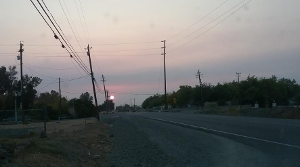
But much worse in Oroville, a second temporary shelter area. (That sun is actually an orange color – my phone did not pick it up.)

This is the entry to the Chico Airport terminal, with tables full of donated food and treats available for the animals we cared for, and for people in need.
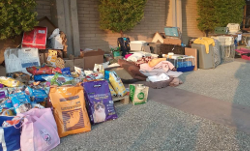
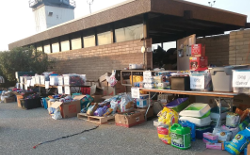
I have nothing but praise for Butte County Animal Control and the North Valley Animal Disaster Group, for their determination to do everything possible to reunite animals with their owners. I worked the three days before Thanksgiving with others examining, treating, and caring for 300 cats (along with some bunnies, guinea pigs, hamsters, rats, mice, and lots of birds) at the Chico Airport. Extensive paperwork is kept with each one.

The building where we cared for the cats is in the background of this picture. In the foreground are veterinary supplies that have been donated.

This is the area by the cat care building where there were more items for people to take.

There are a number of ways that owners are identified. All dogs and cats are searched for microchips. Owners identified that way are notified. All animals recovered by searchers have the place where they were found recorded on their paperwork. Some people with intact houses had to evacuate and could not take their pets with them to people shelters, so we kept their cats or dogs for them until they could go back to their home. Others had lost their home, their job, their clothes, their car, and had no place to keep their pet. Those animals are also being cared for.
They also do everything they can to make sure people do not steal someone else’s pet. Owners were asked for pictures of their pet that were not downloaded from the internet, descriptions of specific or unusual markings, etc. Every day I saw tearful reunions. Some were able to take their pets home. Some could not but visited them daily. Some did not find their pet that day but returned to try again.
The three main things we treated were stress diarrhea, upper respiratory disease (especially sneezing, made worse by the smoke and by stress), and anxiety with lack of appetite. I had a chance to use acupuncture on one poor cat who lay in a cage facing a corner, not eating or drinking much, and very depressed. He was being treated with fluids and a drug to stimulate his appetite. I added an acupuncture treatment and he started eating and drinking. Also hissing. Which, in his case, was a very good thing – interacting with the world again.
I was also happy to see that probiotics were being given to most cats. I wish there had been enough to give to all of them.
Pets that needed extensive care were sent to veterinarians and to UC Davis. All veterinarians donated their services for free.
Every day somebody found their pets. The last day I was there, a man took all 11 of his cats back home. (He was ordered to evacuate, and did not have any place else to keep them.)
Cage cards from pets that went home.
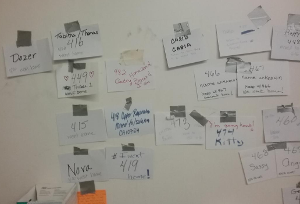
Animals are scattered among a lot of places right now. One website has “mugshots” of all animals whose owners have not yet been identified, and posting it on their website. They hope to have all unclaimed animals on that site soon.
https://sites.google.com/view/campfirerescuedanimals/
Animals that had to be left behind in areas not yet reopened to their owners are being fed by volunteers. They are also leaving food out for all the frightened cats that have been gradually emerging. Cats were being brought in each afternoon that I worked – some just frightened, some with singed whiskers, and some with badly burned paws.
HSUS rented a warehouse and is housing animals which are not sick, and whose owners have been identified. Chico airport houses animals which are sick (from stress and from burns) and animals whose owners have not yet found them. A similar operation is currently in Oroville. Pets are also being housed in other animal shelters and a number of veterinary hospitals.
There were many volunteers devoting their time and labor. There is an organization of chefs who cooked and served food for survivors and the volunteers.
https://www.worldcentralkitchen.org/chefsforcalifornia-medocino
A surprising (to me) number of volunteers cleaned cat cages and fed and watered cats. Others walked dogs and fed and watered them. One person who was excellent with birds cared for them, and helped the vet I worked with who decided which ones needed treatment. She and I both treated a rabbit with sniffles and an irritated eye.
I have seen some complaints about owners having difficulties finding their pets. With over 1600 animals rescued, and so many different places they were being kept, I am amazed at how many had their owners identified. I have confidence that if their pet is there, they will be united with their owners.
I would love to be able to fund research to determine the best probiotics and other natural treatments to help prevent stress-related diseases in situations like this. Donations help us support practical research that helps save pets’ lives.
Root Causes
The Root Causes of Diseases
Nancy Scanlan, DVM
Integrative medicine is always looking for the absolute root cause of a disease. For example, in humans, shingles is a painful disease that may appear years after a person had chicken pox. The virus which causes shingles is never completely destroyed when chicken pox symptoms go away. Instead, it goes to live inside nerve cells, and when a person gets older, it may cause painful inflamed skin eruptions known as shingles.
So is inflammation the cause of shingles? No – it is a result of the disease (although chronic inflammation does play a part in the cause of many diseases).
Is the virus the root cause of shingles? No – although its activity causes those signs, the reason it appears in older people is that their immune system is weaker and can no longer keep the virus locked up in its home inside nerve cells. Conventional medicine has finally recognized that this is the primary problem, and has created a vaccine to try to stimulate the immune system to fight off the virus. But that is only effective in about 50% of cases. Stronger immune systems can be stimulated enough to fight it off. Weaker immune systems still have problems. Conventional medicine does not yet recognize complementary ways to help weak immune systems become stronger.

Conventional medicine also has a near miss when treating mild form of Reactive Respiratory Syndrome. People with this problem start having breathing problems that feel like asthma: they can’t get enough air, they feel like their lungs aren’t expanding enough, and that their airways are not opening up. These problems come and go, like asthma does. But if you ever run into this, your doctor can tell if it is true asthma by measuring the oxygen levels in your blood. With an asthma attack, the levels go down. With the Syndrome, they stay normal.
The whole thing starts with a mild runny nose and post nasal drip, from a mild cold or allergy. There are a few white blood cells in that drip – not enough for you to see, but just enough to cause inflammation wherever they go. The nose is slightly inflamed, and the next step is a mild sore throat. Off and on, very mild, nothing to worry about. Except the throat has those same cells, which migrate down into the lungs, where they finally get a big enough reaction that the lungs become inflamed.
Using inhalers at this point can make things worse and turn it all into real asthma. But if you fix the runny nose instead, the whole thing goes away. That is a perfect example of both treating the root cause, and using a drug that makes a chronic disease worse instead of better. Fortunately, current medicine recognizes this, although not all doctors do.

Using Chinese medicine to recognize the pattern (like the runny nose problem) that is at the root of the disease, is one way to deal with other chronic diseases such as Cushings Disease. Sometimes we can track a problem piece by piece, such as the time that I saw a dog with skin cancer on one hind leg and arthritis on the opposite hip. Because of the arthritis, the dog put more weight on the good leg. That made the good leg hurt, at the hock. The dog licked the hock constantly. (He was a Doberman, and Dobies are famous for licking holes in themselves.) Cancer is often associated with inflammation. All that licking kept that hock inflamed, and cancer developed. I treated the hip, the Dobie stopped licking his leg, and the cancer went away. So did the big sore that had covered that leg for years. Root cause: bad hip.
Why don’t more veterinarians use integrative medicine? They are waiting for the proof, especially in the form of research articles. Dr. Bannink has a great research project that needs to be funded. It has a method of treating hemangiosarcoma, a disease with a survival time of just months. With her treatment, dogs have survived for years. We have just started our Winter Fundraiser, and we have a pledge to match donations from pet owners, up to $25,000, and from veterinarians, for an additional $25,000.
Help save dogs’ lives.